
Plug in
Water circulation and lighting are built into the module, rather than a separate fixed planting installation.
 概念效果圖 / Concept visualisation
CANVIVA · Technology
Structure, root-zone material and scheduled care work together as one living system.
01 · Furniture-like modular design
Planting, water circulation and grow lighting are integrated into a self-contained module. Once positioned, filled and configured, it runs from a power connection—without a separate on-site renovation for the system, reducing strip-out waste while the space stays in use.
Water circulation and lighting are built into the module, rather than a separate fixed planting installation.
Reduce changes to existing finishes and work with the space already there.
Coordinate delivery and setup around the site to minimise disruption to work and trading.
This describes the self-contained module. Access, floor loading, power and safe restraint must still be checked before delivery. Filling, commissioning and ongoing care remain necessary; unusual sites and custom integrations need a separate assessment.
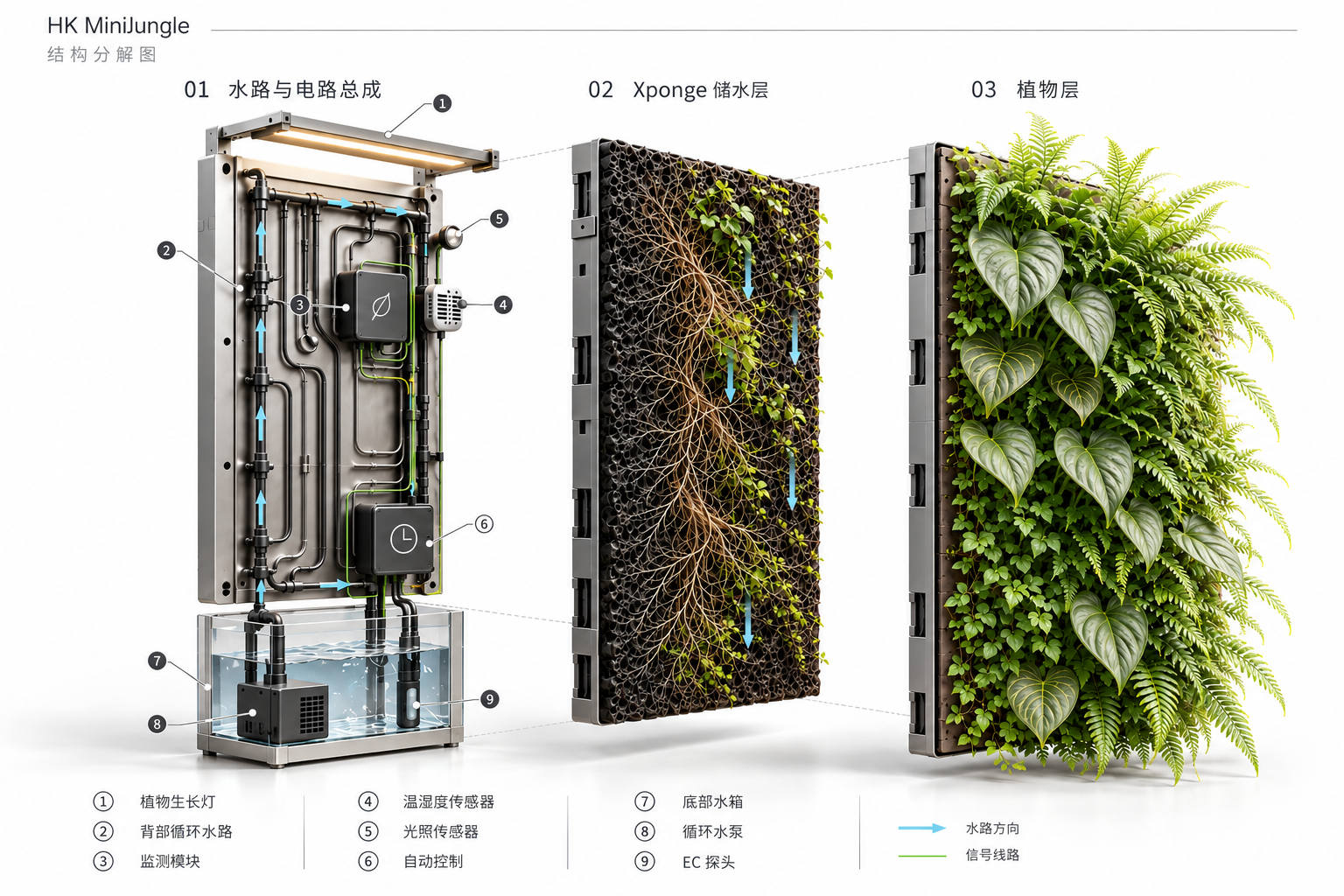 Concept visualisation
Supplied concept system diagram, not a construction drawing. Sensors and control components remain subject to the confirmed physical configuration.
Rear pipework connects the reservoir and circulation pump; lighting and control components are arranged separately from the planting layer.
Supports roots and buffers available moisture between irrigation cycles; the material principle is explained below.
Plant selection considers light, foliage and growth needs alongside composition and practical care.
02 · Xponge · Patented growing matrix
Concept visualisationMiniJungle describes Xponge as a porous polyurethane-based growing matrix that supports roots and buffers moisture. It is not a fertiliser.
Roots need moisture and oxygen. The design aims to combine water retention and aeration in the root zone rather than keep roots in stagnant, oxygen-poor water.
Connected larger pores provide air pathways around roots.
Smaller pores hold moisture by capillary action for root uptake.
A more stable root environment supports growth, but suitable plants, nutrient solution, light and care still matter. This is not a guarantee against root rot.
Start with the roots
Vertical planting must manage moisture distribution, anchorage and aeration together. Wet and dry patches can coexist; more frequent watering alone is not a complete answer. Xponge approaches this through a designed solid–liquid–gas environment.
DualFlow · Two pathways
DualFlow assigns complementary roles to different pores: smaller pores retain moisture by capillary action, while larger connected pores support aeration and drainage. Water retention leaves room for air pathways; installation, root growth and irrigation conditions still matter.
The pump delivers reservoir water and nutrients to the planting layer.
The matrix retains some moisture alongside drainage and return flow, while air pathways do their separate job.
Roots use available moisture and its dissolved nutrients between pump cycles.
Pore distribution, connectivity and structural stability matter over time. These are design aims, not a claim that every configuration is immune to ageing, blockage or replacement; durability for this product requires testing.
The brand describes a calcium–silicon root-promoting system. Inclusion in this product, composition, dose and plant-specific comparative results remain unconfirmed; no universal rooting benefit is promised.
No. The matrix provides the physical root environment; nutrient solution supplies nutrients, circulation transports water and lighting supplies light. Water-level checks, plant observation, tuning, cleaning, pruning and replacement remain part of care.
Principle references (brand technical descriptions, not independent certification of this product): DualFlow structureWhat is Xponge?
Further references: MiniJungle matrix / DualFlow FAQBrand description of the patented architecture
Materials required: the actual matrix grade, pore/water-retention/aeration tests, durability, calcium–silicon formulation applicability and plant-specific growing validation. Brand performance figures are not automatically promises for this product.
03 · Scheduled care
These are the supplied reference operating settings, not a universal recipe. Adjust for plants, environment, season and reservoir configuration.
Water circulation
The pump sends reservoir water and nutrients through the rear pipework and root zone, with return flow to the reservoir. Scheduled circulation is separate from manual top-ups.
Check water level and plants regularly. Confirm top-up quantities and nutrient concentration; do not add fertiliser by calendar alone. Attend to low water or stressed plants earlier.
Grow-light schedule
Grow lights run by day and switch off at night: a reference 12-hour light/12-hour dark schedule. Other room lighting also affects the actual dark period.
“Sleep” is a useful metaphor, not human sleep. Many plants need a nightly dark period; longer lighting is not automatically better. Requirements vary with species, intensity and growth stage. This 12-hour setting is a system reference, not a universal biological standard.
Read: University of Minnesota Extension on seedling light and dark periods
Materials required: reservoir capacity, pump flow and coverage, nutrient formula/EC range, lighting PPFD and distance, and plant-specific tuning/test records.
Discuss the site and technical configuration